I just finished Neil Gaiman's The Graveyard Book, and I am absolutely itching to begin a new school year and share the title with my students. Being that this is my first post on this blog, however, that statement may require some explanation before I get into the book itself.
 My name is David, and I teach freshman English and AP Literature at a suburban Chicago high school. I've created this blog for a number of purposes--as a reader's advisory tool for my students, as a way to fulfill the requirements of an assignment for grad school, and as an outlet for my own desire to share my thoughts on books, poetry, and happenings in the literary world. While you never quite know what a project will become, my plan is to post regularly about what I'm reading and what I think about it (a la Nick Hornby's The Polysyllabic Spree), to preview books that are set to come out, and to share articles and stories related to reading (the literary world has its gossip, too). I often tell my students that even with the advent of television, audio recording, and digital technology, the printed word continues to be our most prolific and important tool for the exchange of complex ideas. Here, I hope to promote that exchange--and to have some fun doing it.
Published in 2008 by HarperCollins, The Graveyard Book is the strange and chilling story of Nobody Owens, a boy whose family is methodically yet brutally murdered by a "professional" named Jack at the book's opening. Just a toddler when the crime occurs, Nobody--or "Bod" as he'd come to be called--escapes the scene quite by accident, climbing out of his crib and out the front door Jack has left open. Bod, pursued by Jack, unwittingly makes his way to a local graveyard and slips to safety between the bars of the gate, where he is taken in by the unlikeliest of "people"--the Owens, husband and wife shades who make the graveyard their home.
 |
| His family murdered, Bod is raised by the ghostly inhabitants of a graveyard |
My two favorite aspects of The Graveyard Book have to be Gaiman's writing style and the occasional but very important illustrations by Dave McKean (the latter of which provides more than simple support to the story). Gaiman's poetic voice makes the book's somewhat elusive ideas and images extremely concrete. Take his description of Bod's fall from a tree, and the ensuing pain he experiences:
"A snap, loud as a hunter's gun, as the branch gave way beneath him.
A flash of pain woke him, sharp as ice, the color of slow thunder, down in the weeds that summer's night." (p. 101)
Perhaps ironically, Gaiman's complex figures of speech here make the image clearer. I especially like the phrase "the color of slow thunder," which--follow me here--takes a physical sensation, pain, and describes it by comparing it to the visual quality (the color) of an auditory event, thunder. Somehow the description fits perfectly, and the book is filled with similar lines that deepen the ideas without coming across as overly intellectual or false.
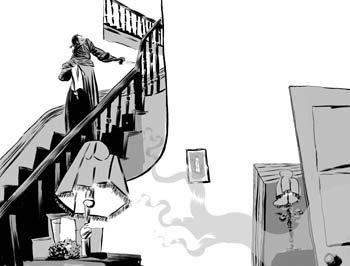 |
| McKean's illustrations help to tell the story, as in the mist that seems to draw Bod away from danger |
The Graveyard Book is a great piece with which to begin my blog, since not only the book itself, but the story of how I came to read it, is so interesting. Firstly, I've avoided the horror genre pretty much my entire reading life. The only horror title I've ever read, in fact, was Clive Barker's The Thief of Always--which is odd, actually, because it was one of my favorite books growing up, and you'd have thought it would be a stepping stone into the genre. I'm the type of person, however, who curls up terrified at even the most ridiculous horror movies. So when a professor of mine presented us with an assignment to read at least seven books from a genre we regularly avoid, I picked horror immediately--not only because it was one of the few he listed in which I don't read, but because I know it's one of my students' favorites, and a knowledge of the genre would help me recommend titles. But now that I've read a few texts, I've gotten hooked, and over the next few months I'll post about others I've read as I continue to complete the assignment.
 |
| Neil Gaiman, author of The Graveyard Book |
Have you read any of Gaiman's books? What were your favorites? Can you suggest anything similar, whether in the horror genre or otherwise? Let me know via a comment--I'd love to hear about it.
Happy reading.

David, I have never read any of Gaiman's books. I, too, have been reluctant to read books from the horror genre. I did, however, enjoy an event in Elgin last summer, called Walk-about Theater, which presented stories and poems by Edgar Allen Poe. They presented "The Fall of the House of Usher," "The Tell Tale Heart," "The Bells," and another one I can't remember the name of.
ReplyDeleteI enjoyed reading specific examples of the Gaiman's writing in your blog, such as the one in which he compares "the color of slow thunder" to a feeling of pain.Your analysis of this book demonstrates much depth! Thanks for sharing it!